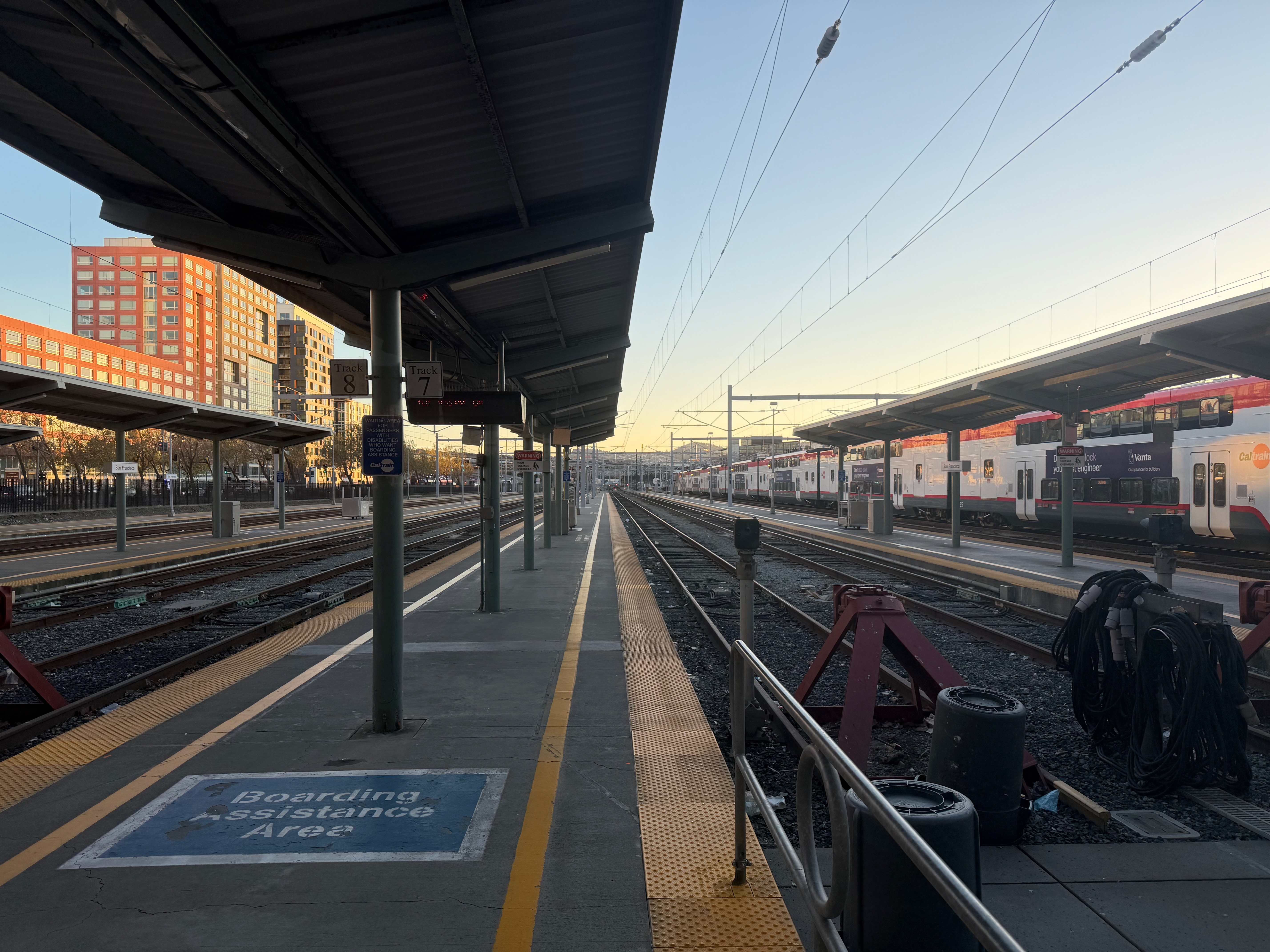
 The platforms at San Francisco, with portable lifts and no mini highs.
Last updated: 2026-1-21
This page documents the ways in which Caltrain stations are accessible to wheelchair riders. The term "accessible" on this page means accessible by rolling, without any steps.
Caltrain publishes a page on their website listing wheelchair-accessible stations. My page provides more detail about the aspects of accessing and using the stations with a wheelchair.
Bridge plate: A flat object that a Caltrain employee places across the gap between the mini-high and the train, allowing a wheelchair rider to roll onto or off of the train. The bridge plates that are currently used have four sections that fold up into a more compact form. They're stored near the designated wheelchair section on the second train car from the north end of the train.
Grade crossing: A place where people can cross tracks at the same level of the tracks, or at grade, rather than via a tunnel or bridge. When a train is approaching, they have lights, bell sounds, and physical arms that warn people not to cross. Some are big, for road vehicles, and some are small, for people.
Island platform: A single platform between two tracks. People can access trains on the track on either side of the island platform.
Mini-high: A short, concrete platform section that's higher than the standard platform height. Wheelchair riders should wait on or near the mini-high before the train arrives. When the train arrives at the station, a door should align with the mini-high. Then, a Caltrain employee places a bridge plate across the gap between the train and the mini-high.
Side platform: A platform alongside just one track. Typically, a station with side platforms will have two of them, with two tracks in between. You must wait for the train on the correct side platform because you can't quickly get to the other platform once the train arrives.
| Station name | Accessible station | Mini-high | Ground level / Ramp / Elevator | Smooth platform | No grade crossings | Side or island platform |
|---|---|---|---|---|---|---|
| San Francisco | ✅ | ❌ | Ground level | ✅ | ✅ | 6 islands |
| 22nd Street | ❌ | ❌ | Stairs only | N/A | ✅ | Side |
| Bayshore | ✅ | ✅ | SB elevators, NB ground level | ? | ✅ | Side |
| South San Francisco | ✅ | ✅ | Ground level and ramp | ✅ | ❌ | Island |
| San Bruno | ✅ | ✅ | Ramps and elevators | ? | ✅ | Side |
| Millbrae | ✅ | ✅ | SB ground level, NB elevators | ✅ | ✅ | Side |
| Broadway | ❌ | ❌ | Ground level | N/A | ❌ | SB Side, NB tiny island |
| Burlingame | ✅ | ✅ | Ground level | ? | ❌ | Side |
| San Mateo | ✅ | ✅ | Ground level | ? | ❌ | Side |
| Hayward Park | ✅ | ✅ | Ground level | ❌ | ❌ | Side |
| Hillsdale | ✅ | ✅ | Ramps | ✅ | ✅ | Island |
| Belmont | ✅ | ✅ | Elevator | ? | ✅ | Island |
| San Carlos | ✅ | ✅ | Ramps | ? | ✅ | Side |
| Redwood City | ✅ | ✅ | Ground level | ❌ | ❌ | Side |
| Menlo Park | ✅ | ✅ | Ground level | ? | ❌ | Side |
| Palo Alto | ✅ | ✅ | Ramps | ✅ | ✅ | Side |
| Stanford | ❌ | ❌ | N/A | ? | ❌ | Side |
| California Ave | ✅ | ✅ | Ground level and ramps | ✅ | ✅ | Side |
| San Antonio | ✅ | ✅ | Ground level | ❌ | ✅ | Side |
| Mountain View | ✅ | ✅ | Ground level | ❌ | ❌ | Side |
| Sunnyvale | ✅ | ✅ | Ground level | ✅ | ❌ | Side |
| Lawrence | ✅ | ✅ | Ground level and ramps | ✅ | ✅ | Side |
| Santa Clara | ✅ | ✅ | Ground level and ramps | ? | ✅ | Side |
| College Park | ❌ | ❌ | Ground level | N/A | ❌ | Tiny strips |
| San Jose | ✅ | ✅ tracks 2, 3, 4, 8, 9; ❌ tracks 5, 6, 7 | Ramps and lift | ✅ | ✅ | 4 islands |
| Tamien | ✅ | ✅ | Elevator | ✅ | ✅ | Island |
All the platforms at San Francisco station are at street level. No elevators or ramps are needed to access the platforms from the street.
The platforms at San Francisco, with portable lifts and no mini highs.
None of the platforms have mini-highs. Wheelchair riders must have a Caltrain employee use a manually-operated lift to board and de-board trains.
22nd Street station is not wheelchair-accessible. No ramps, elevators, mini-highs, or manual wheelchair lifts exist here.
The only way to access the platforms is via two sets of stairs from 22nd St, one for each of the northbound and southbound platforms.
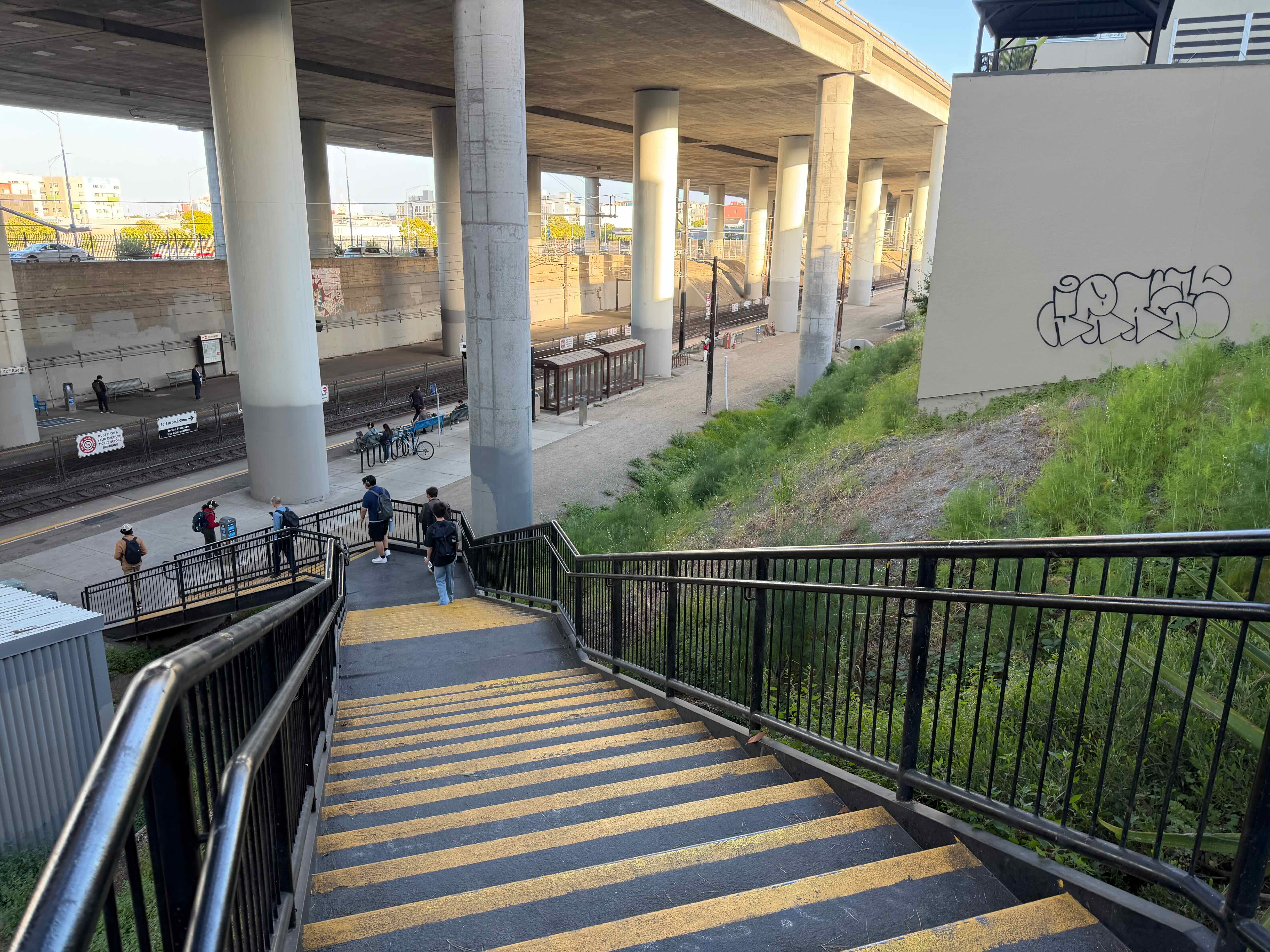 The stairs to the southbound platform at 22nd St
Bayshore station has two side platforms.
The northbound platform is at street level, accessible without a ramp or elevator from the street. Accessing the northbound platform requires crossing a single track used infrequently by freight.
The southbound platform is only accessible via a bridge over the tracks from the northbound platform. Each side of the bridge is accessible via a single elevator.
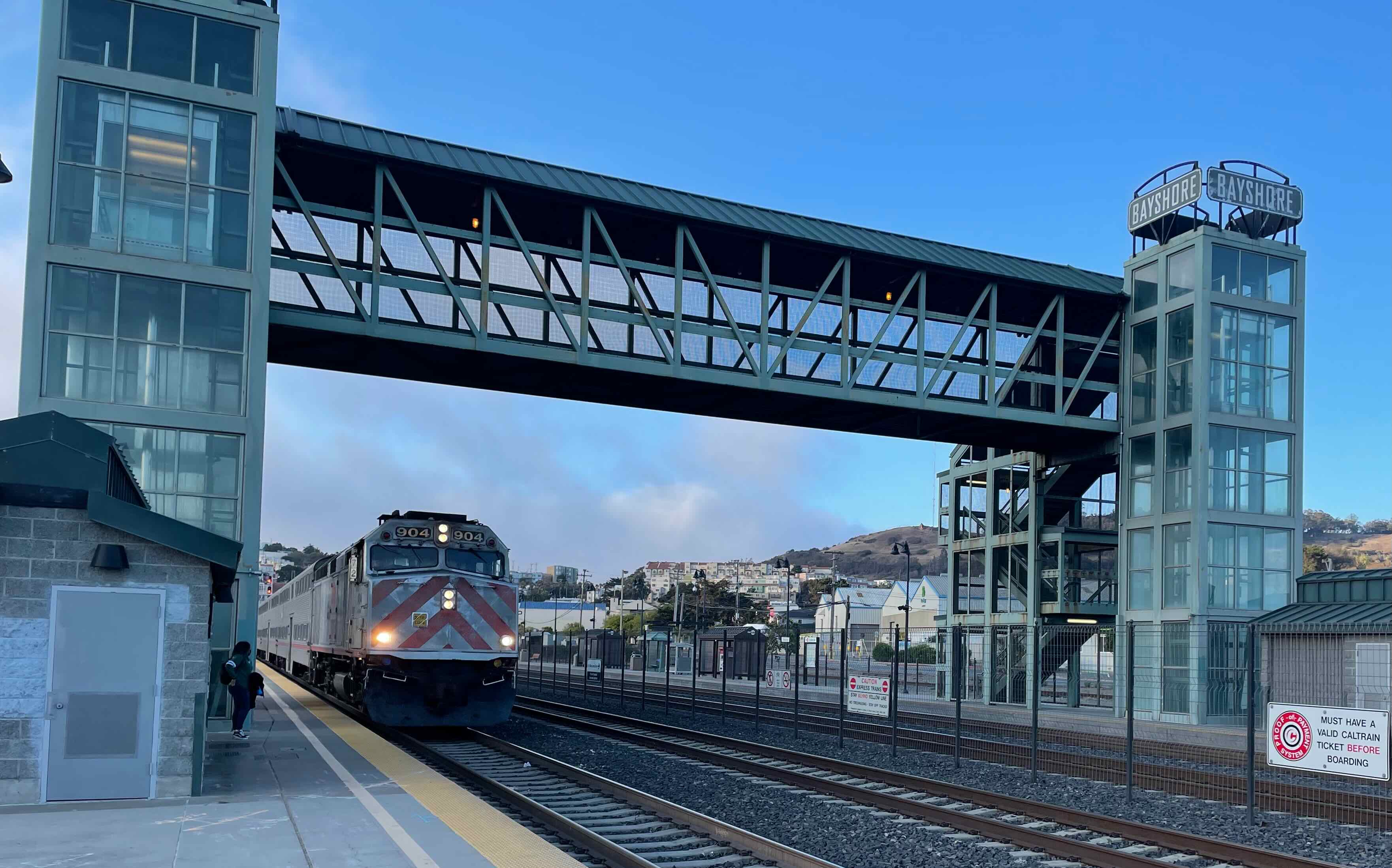 The bridge at Bayshore
South San Francisco station has an island platform. This platform is accessible via a ramp at the south end, leading to downtown South San Francisco.
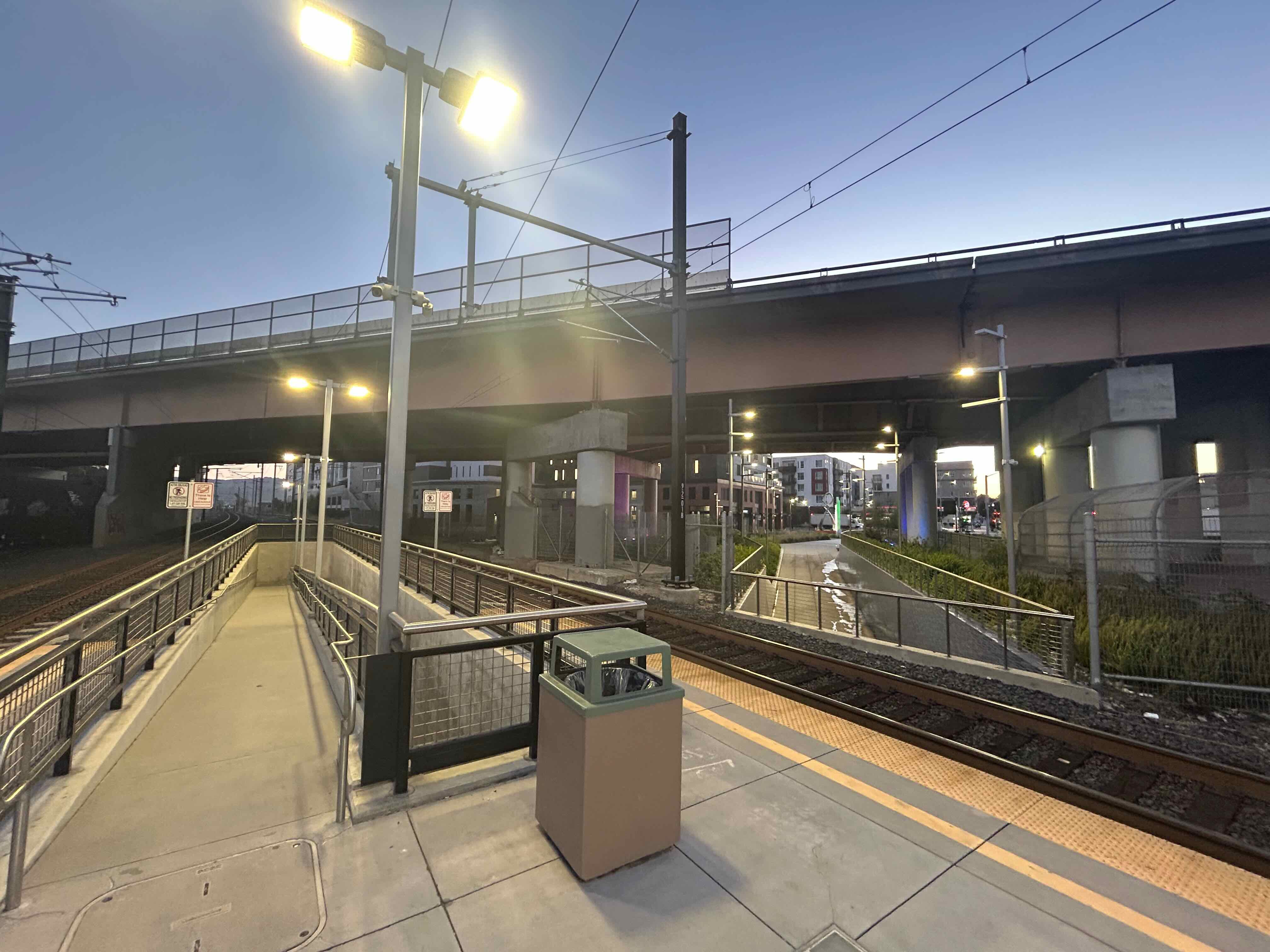 The ramp from the platform to the tunnel under the tracks, with the ramp to downtown at right
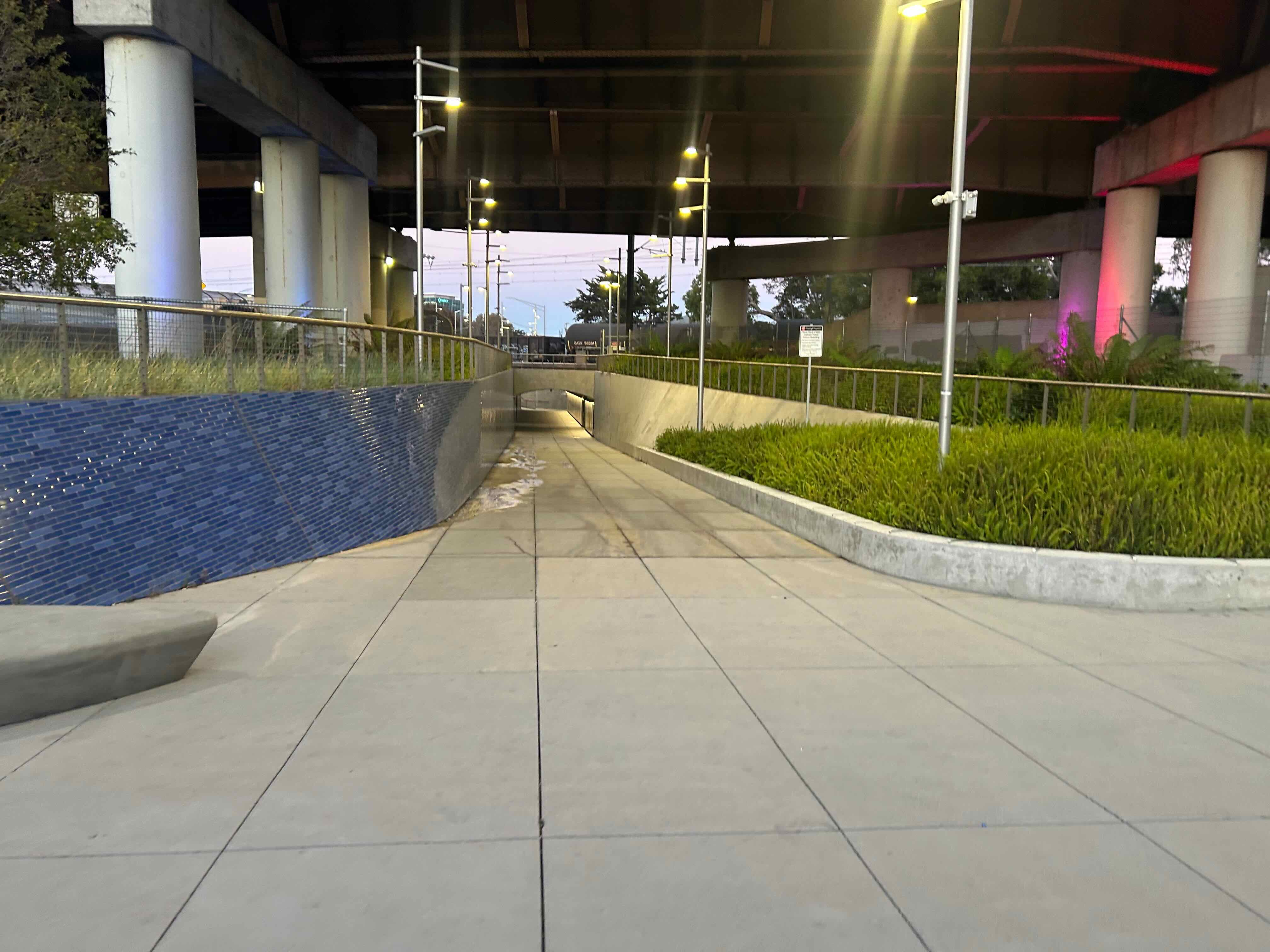 The ramp from downtown to the tunnel under the tracks
At the north end of the platform, a grade crossing for people crosses the southbound track, providing access to the parking lot.
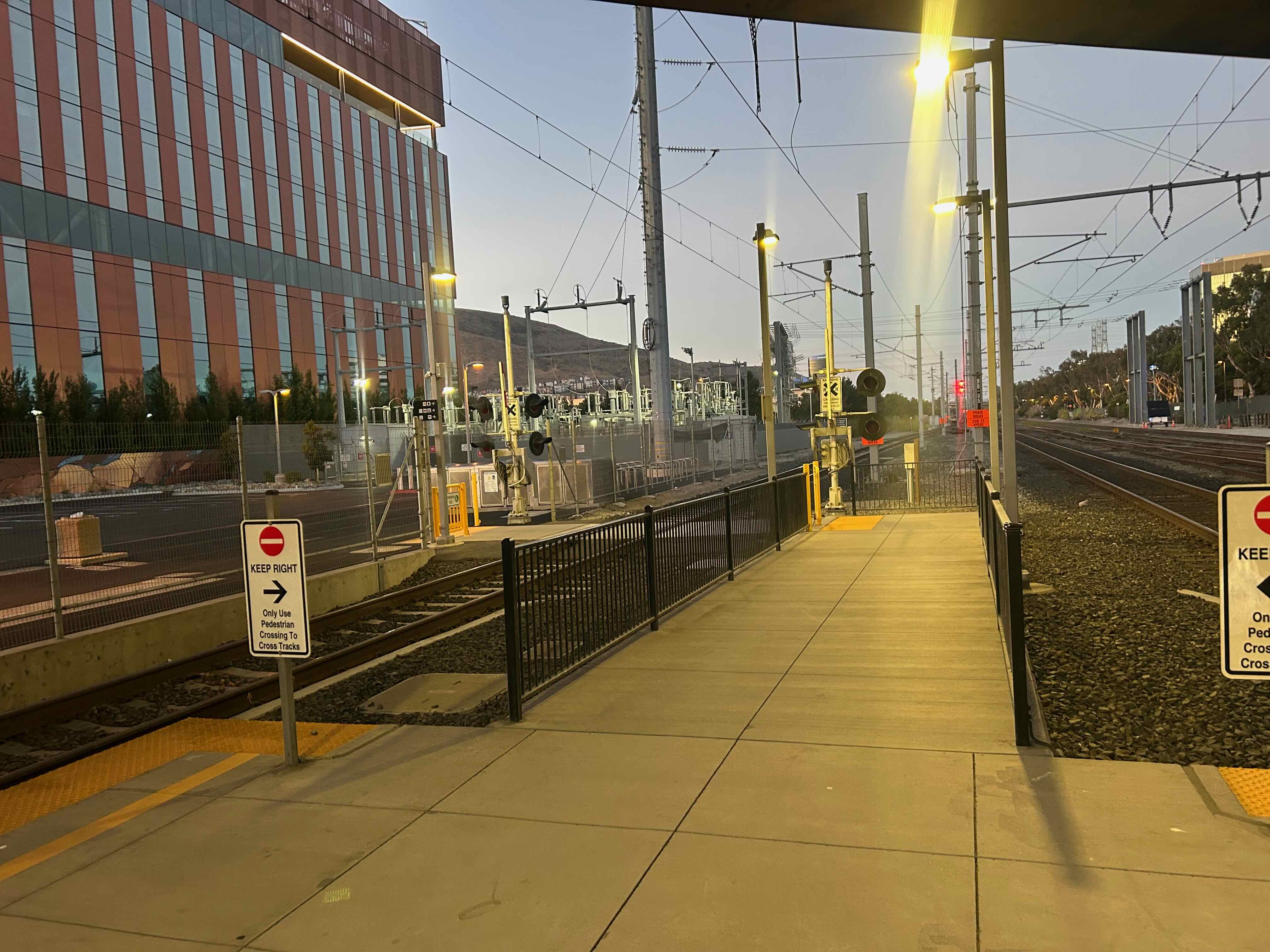 The crossing at the north end of the platform
San Bruno station has two side platforms, elevated above ground level.
A ramp is at both ends of both platforms. An elevator is near the north end of both platforms.
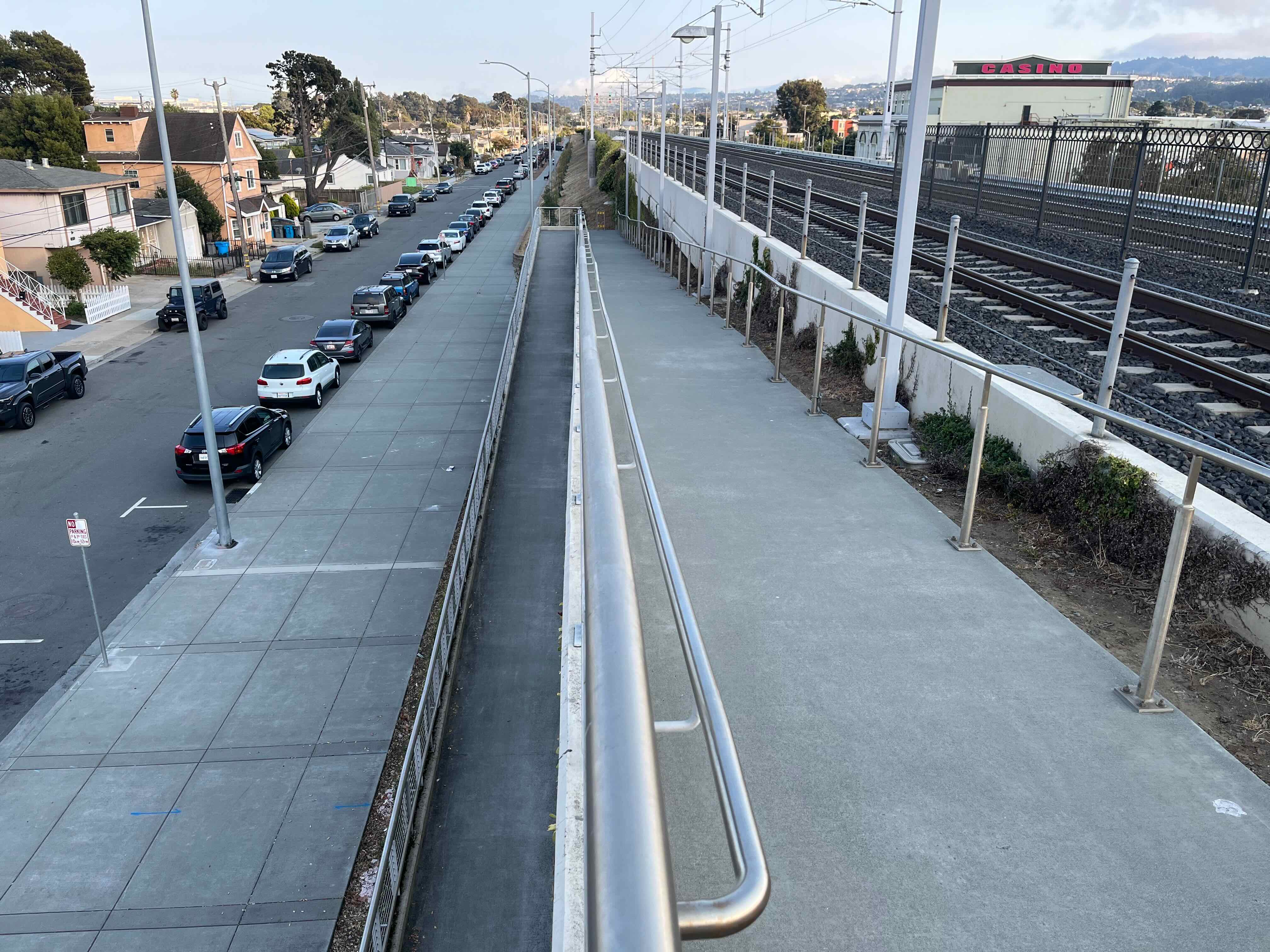 The ramp at the south end of the northbound platform
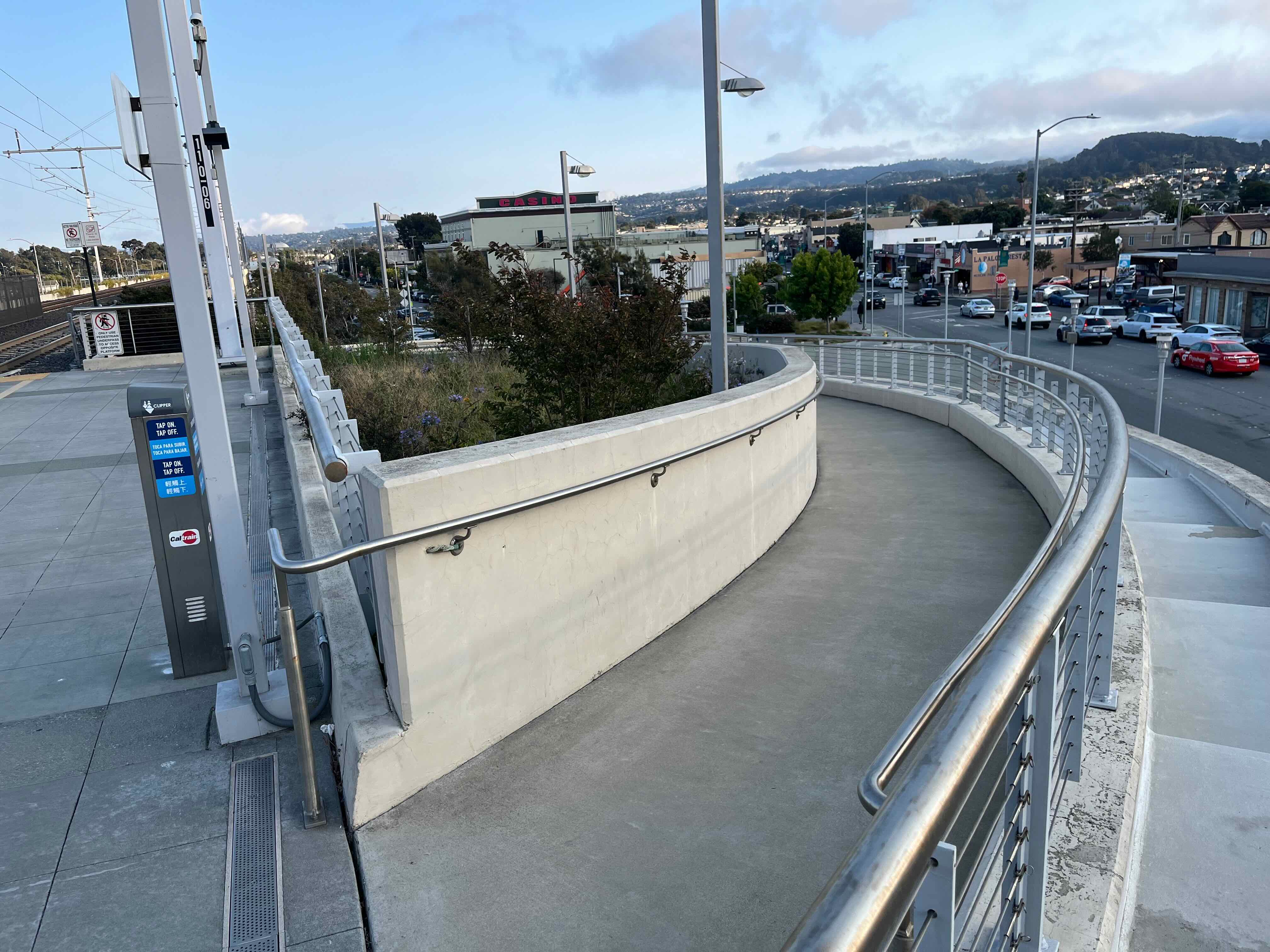 The curvy ramp at the south end of the southbound platform
Millbrae station has two side platforms. The northbound platform is shared with BART, and BART has another island platform. An elevated mezzanine is the only way to get from one platform to another.
The southbound platform is the only platform that's accessible directly from the street, with no ramps or elevators.
The northbound platform is only accessible from the street by riding an elevator up to the mezzanine and then riding another elevator down to the northbound platform.
If transferring from BART to a southbound Caltrain, you must use the mezzanine to get from the BART platform to the southbound Caltrain platform. At least 4 minutes are needed to transfer from BART to Caltrain, to account for the time it takes to get to the first elevator, wait for it, ride the elevator, tag out of the BART fare gates, traverse the mezzanine, wait for the second elevator, ride the second elevator, and get to the mini-high on the southbound Caltrain platform.
If transferring from Caltrain to BART going northbound, no ramp or elevator is required in the transition from Caltrain to BART.
Broadway station is not accessible. Wheelchair riders must use Millbrae or Burlingame station instead.
Burlingame station has two side platforms at ground level. No ramps are needed to access either platform.
To get from one platform to the other, one must use a grade crossing for people either at the south end along Howard Ave or at the north end along North Ln.
San Mateo station has two side platforms at ground level.
The southbound platform can be accessed from many points on the west side of the tracks.
The northbound platform can be accessed from the street only at the south end of the platform along First Ave.
To get from one platform to the other, a grade crossing is along First Ave at the south end of the platforms.
To access underground parking at San Mateo station, one elevator is near the center of each of the platforms. These elevators descend to a tunnel under the tracks that connects to the parking garage. If they're both working, these elevators and tunnel can be used to get from one platform to the other.
Hayward Park station has two side platforms at ground level.
The northbound platform can be accessed from a parking lot connected to Concar Dr on the east side of the tracks.
The southbound platform can be accessed via a path connecting to Leslie St near the south end of the platform, and a path connecting to 17th Ave at the north end of the platform.
To get between the platforms, a grade crossing for people is at both the south and north ends of the platforms.
Hillsdale station has a single island platform elevated above ground level.
A large ramp is at both the north and south ends of the platform. The ramp at the south end leads to an area under the tracks that connects only to a parking lot and streets to the east of the tracks. To access the west side of the tracks from this area, a single, narrow ramp extends south to the sidewalk along 31st Ave, and a path along the parking lot extends north to the sidewalk on 28th Ave. The ramp at the north end of the platform connects to the sidewalk and a bidirectional bike lane along the north side of 28th Ave..
Belmont station has a single island platform elevated above ground level.
A single elevator near the center of the platform is the only way to access the station without stairs.
Two mini-highs have just been constructed on the platform as of early January 2026.
San Carlos station has two side platforms elevated above ground level.
A ramp on each side leads from ground level, around San Carlos Ave, to each platform.
To get between the platforms, a path connects between the bottom end of both ramps.
Redwood City station has two side platforms at ground level.
The northbound platform can be accessed from several points along the east side of the tracks.
The southbound platform can be accessed from several points along the west side, including a SamTrans bus station.
To get between the platforms, a grade crossing for people is at the south end of the platforms, and a grade crossing is just past the north end of the platforms along Broadway.
Menlo Park station has two side platforms.
The northbound platform is slightly above ground level, and can be accessed via a ramp at the north end of the platform and a ramp at the south end of the platform.
The southbound platform can be access from several points along the west side.
To get between the platforms, a grade crossing for people is at the south end of the platforms, and a grade crossing is at the north end of the platforms along Oak grove Ave.
Palo Alto station has two side platforms elevated somewhat above the surrounding ground.
The northbound platform can be accessed via a ramp at the north end of the platform and a ramp at the south end of the platform.
The southbound platform can be accessed from several points along the west side of the station.
University Ave runs perpendicularly under the station. Each of its sidewalks has two ramps that lead to both the northbound and southbound platforms, for a total of four ramps. These ramps can be used to access the station from University Ave, and can also be used to get between the platforms.
In addition, a ramp at the north end of each platform leads to a tunnel under the tracks, providing another way to get between the platforms.
Stanford station is a legacy station used only for Stanford sports events. It has minimal platforms, and no regular station infrastructure. No trains regularly stop here.
It is not wheelchair-accessible. It has no mini-highs or manual wheelchair lifts. The platforms are narrow strips of asphalt. Caltrain tells wheelchair riders to use Palo Alto station instead.
California Ave station has two side platforms at ground level.
The northbound platform is accessible only from the southbound platform via a tunnel under the tracks, which is connected to each platform by a ramp.
The southbound platform can be accessed near the north end of the platform from the end of California Ave or the parking lot.
San Antonio station has two side platforms at ground level.
The northbound platform is accessible via a short ramp at the south end of the platform, which connects to the intersection of Central Expressway and Mayfield Ave.
The southbound platform is connected to Showers Dr via a short ramp at both the north and south ends of the platform.
To get between the platforms, a ramp at the south end of each of the two platforms leads to a tunnel under the tracks.
Mountain View station has two side platforms at ground level.
The northbound platform can be accessed via a grade crossing for people at each end of the platform, which connects to the southbound platform. It can also be accessed at the north end from the VTA platform by crossing one VTA track.
The southbound platform can be accessed from several points along the west side.
To get between the platforms, a grade crossing for people is at both the north and south ends of the platforms.
Sunnyvale station has two side platforms at ground level.
The northbound platform can be accessed via a short ramp to the intersection of Hendy Ave and Frances St, and via a dirt path at the north end of the platform.
The southbound platform can be accessed from several points along the west side.
To get between the platforms, a grade crossing for people is at each end of the platforms.
Lawrence station has two side platforms at ground level.
The northbound platform can be accessed from a ramp near the north end of the platform or from San Zeno Way near the middle of the platform.
The southbound platform can be accessed near the middle of the platform from French St.
To get between the platforms, a ramp connects from near the middle of each platform to a tunnel under the station.
Santa Clara station has an island platform for northbound trains and a side platform for southbound trains. The other side of the island platform is used by Amtrak and ACE trains.
The northbound island platform is accessible via a ramp from the southbound platform and bus station to a tunnel under the tracks. A ramp connects this tunnel to the island platform, and another ramp also connects the tunnel to Brokaw Rd to the northeast of the tracks.
The southbound side platform is accessible from several points along the southwest side.
To get between the platforms, ramps from each platform connect to a tunnel under the station.
College Park station is not wheelchair-accessible. No ramps, mini-highs, or manual wheelchair lifts exist here.
San Jose Diridon station has an array of four island platforms between pairs of tracks.
Nine tracks are numbered from east to west. Track 1, the eastmost track, is only accessible via a side platform, and Caltrain doesn't use that track. All Caltrain trains are served from the island platforms.
A tunnel runs under the station near the middle of the platforms, perpendicular to the tracks. Four ramps lead from this tunnel north, connecting it to each of the island platforms.
At the east end of the tunnel, a somewhat steep ramp connects to the station building and the street. A small lift is also available as an alternative to this steep ramp.
The west end of the tunnel connects to the VTA light rail platforms. A grade crossing for people across the VTA light rail tracks provides access to streets west of the station.
The track 2/3 and 8/9 platforms have full-width mini-highs serving all those tracks. The track 4/5 platform only has a mini-high for track 4. The track 6/7 platform has no mini-high. A manual lift has to be used for accessing trains on tracks 5, 6, and 7.
Tamien station has a single island platform elevated above ground level.
One elevator to ground level is near the middle of the platform. No ramps connect the platform and ground level.
22nd Street is one of the most-used Caltrain stations, so it's especially egregious that it isn't wheelchair-accessible. Lots of linear space is available along both side platforms, despite the pillars for I-280. Caltrain should install a ramp to street level on each side.
The bridge at Bayshore is kind of a big problem. It was built in the early 2000s, but was in such bad condition that it had to be fully renovated in 2024-2025. It's only necessary for accessing the southbound platform, and requires two slow elevator rides. Ideally Caltrain should build a tunnel with ramps connecting the north end of the southbound platform to the northbound platform and Tunnel Ave, eliminating the need to use elevators.
Broadway station is a legacy Southern Pacific station that was never significantly upgraded, as most other similar stations were. As many legacy stations had, it has a southbound side platform and a small strip between the tracks used for accessing the northbound track. Getting to this strip requires crossing the southbound track. Because of this dangerous configuration, the "hold-out" rule is in effect, where only one train is allowed to be in the station at a time. It has low ridership, probably partly because it only has service on weekends.
Making the northbound track wheelchair-accessible is tricky with the current configuration. Another side platform would need to be installed, which may be impossible with the amount of space available on that side. The southbound track could easily be accessed right now, if a mini-high was installed or if a manual lift was present at the station.
The future of the existence of Broadway station is in doubt, given the added expense of building a grade separation with Broadway (the road) that would be long and flat enough to rebuild an elevated station. It's unlikely Caltrain would do any upgrades to the station in the meantime, before the grade separation is built.
At least one elevator at San Mateo station is often out of service. Caltrain's speaker system repeatedly announces this. But San Mateo station is completely wheelchair-accessible without the elevators. The elevators are only needed for accessing the underground parking garage. Without knowledge of San Mateo station's layout, this alert is misleading.
Hillsdale, despite being a new station, has bad station access from the west side of the tracks. Hillsdale Mall is right on the other side of El Camino, but getting there requires exiting the station on the east side of the tracks, following a narrow path south along the parking lot, descending a narrow ramp to 31st Ave, then turning right onto the sidewalk along 31st Ave to go under the tracks.
Caltrain should allow people to exit and enter directly from the west side along El Camino,. That may involve buying property from, or coming to an agreement with, a property owner along El Camino, such as whomever owns the Michael's building. Parking lots among the buildings on those properties make it physically easy to create access for people between the station and El Camino. Currently, all that physically prevents people from accessing the station from the west is the existence of a fence and the lack of a short concrete ramp.
Belmont's island platform should have been built with at least one ramp connecting it to ground level. It should be upgraded to have a ramp, so riders aren't reliant on the single elevator. Newer island platforms, like South San Francisco and Hillsdale, have ramps.
While mini-highs were constructed at most stations by the end of 2024, construction only started at Belmont in December 2025. As of January 2026, two mini-highs have been built. Unfortunately, Caltrain didn't built a single, wide mini-high, like at Hillsdale, so riders have less room to navigate on the narrow mini-highs when boarding and de-boarding trains.
Some platforms, like Mountain View and San Antonio, are paved with "stamped concrete," concrete that has had a texture stamped into it before it cures. This is an aesthetic choice that provides no other benefit. It presents an uncomfortable and difficult-to-navigate surface for wheelchair riders. Stamped concrete should be replaced with standard, smooth concrete on all platforms and station areas.
The table above documents which platforms are smooth.
A sunken area below the tracks can only be accessed by stairs. It poses an obstacle to wheelchair users wanting to get from one side of the tracks to the other. Just two narrow level areas are at the north and south ends of this inaccessible sunken area.
A path exists at the north end of the northbound platform, but it connects only to a set of stairs that lead to a sidewalk along the north side of San Antonio Rd. Central Expressway has no sidewalk along its east side, so this path isn't useful for any other purpose than accessing the stairs.
College Park station is the most archaic, yet still used, Caltrain station. Only a few trains per day on weekdays stop, and the platform is a short length of asphalt. Only some doors near the north end of the train are opened here. It mainly exists to serve high school students at the nearby Bellarmine College Prep high school. If any students use a wheelchair, they're out of luck, and their public transit options are the nearby VTA 22 and 61 bus lines.
The boarding area wheelchair riders are required to use is near the north end of all Caltrain platforms, so wheelchair riders usually have no reason to access the south end of the platforms at San Jose. If wheelchair riders are to try to access the south end of each platform, they'll find that only platform 2/3 and 4/5 have ramps extending from the tunnel to the platform. From the tunnel going south, only stairs connect to platforms 6/7 and 8/9.
the ramp at the east end of the tunnel is too steep for many disabled people, and the lift is small and slow. Ideally, the ramp should have a gentler slope. It is nice that the ramp is the primary and only way to get to and from the tunnel. Stairs are not the primary path, so the ramp is nice and wide.
Mini-highs are missing for tracks 5, 6, and 7. The lack of mini-highs on 3 of the 8 tracks makes using this station unpredictable and inconsistent.
Like Belmont station, Tamien should have a ramp connecting the island platform to ground level. The elevator at Tamien has been out of service for months on end in recent years, emphasizing the importance of having a ramp. Newer island platforms, like South San Francisco and Hillsdale, have ramps.
Caltrain only permits three wheelchair riders on each train. If you wait for a train, it arrives, and it already has three wheelchair riders on it, Caltrain will deny you a ride. This is unacceptable.
Each one of Caltrain's electric train cars, excluding the car with the bathroom, has two areas designated for wheelchair riders, one next to each door, marked with a wheelchair symbol. Assuming one wheelchair rider uses each spot, a train could accommodate 14 wheelchair riders. If two wheelchair riders pack into each spot, 28 wheelchair riders could be on one train.
Unfortunately, Caltrain only allows wheelchair riders to board the car with the bathroom. The mini-highs are placed along the platforms to only align with the northmost door of this car. If a manual lift is used, wheelchair riders can theoretically get into any car. In practice, wheelchair riders have ridden on other cars, but this is rarely allowed.
Caltrain should accommodate as many wheelchair riders as show up to ride the train. If the car that aligns with the mini-high has all its wheelchair spots filled, a manual lift should be used to allow wheelchair riders to board another car. Caltrain's electric trains have more than 600 seats, and when those seats fill, even more people crowd onto the trains, standing in the aisle. Caltrain doesn't attempt to limit the number of non-wheelchair-using riders, so they should not limit the number of wheelchair riders.
Caltrain may blame the limit on wheelchair riders on the existence of one mini-high at each station. The single mini-high is a choice Caltrain made. They also made the choice not to implement level boarding, which ultimately limits access to the trains. On train systems with level boarding, like BART, there is no limit, or way to limit, the number of wheelchair riders on a train.
Level boarding refers to a platform-train interface that is level with minimal gaps, meaning wheelchair riders can roll on and off of the train unassisted. This is how BART, VTA light rail, SMART, and countless other train systems around the world work. Level boarding allows wheelchair riders to access trains more seamlessly, without having to rely on employees to deploy bridge plates or manual lifts. It makes getting on and off of trains much faster.
Caltrain, like Amtrak, and unlike BART, is a part of the national rail network, and Union Pacific operates freight trains on Caltrain's tracks. The system is therefore subject to rules imposed by both the Federal Railroad Administration and California Public Utilities Commission. These rules include a minimum loading gauge, which is the cross-sectional area above the track that Caltrain must keep clear, to allow for freight trains to pass through without running into things. This limitation is the main reason Caltrain doesn't have level boarding.
The freight trains aren't going anywhere, because they're the best way of moving heavy freight to and from points along the peninsula. Caltrain should find a way to build platforms close enough to its trains to facilitate level boarding. Solutions exist, such as gauntlet tracks used on the SMART system, where two sets of tracks run along the platforms, one being far enough away to allow freight trains to pass. Many passenger trains around the world are fitted with gap fillers, which are little automated bridge plates that extend from the train once it stops at the station, allowing for the platform to be farther away from the train, though much closer than the current mini-highs.
Caltrain's lack of level boarding is its single biggest accessibility issue. Implementing it should be one of Caltrains highest priorities.
Caltrain has certain stations that exhibit great attributes of accessibility. Hillsdale has an island platform, making it trivial for passengers to adapt to single-tracking, and a great, wide ramp at both ends of the platform. San Bruno has 4 (4!) ramps linking the platforms to ground level, and an elevator for each side platform. Those are so many options! Palo Alto has four ramps to University Ave, an additional under-crossing at the north end, and access from both platforms to various areas on both sides. Caltrain could take inspiration from these and add more entrances and access routes at other stations.
Caltrain's South County Connector service is aimed at people commuting from areas south of San Jose to jobs along the peninsula or San Francisco. It only runs on weekdays, and only in the peak direction (northbound in the morning, southbound in the afternoon). It only has 4 trips in each direction each day.
Instead of the newer electric trains used between Tamien and San Francisco, the South County Connector uses older diesel-powered trains with Bombardier BiLevel passenger cars. These have the same floor height as the electric trains. In theory, these trains can use mini-high platforms with a bridge plate. Unfortunately, Caltrain hasn't installed mini-highs at any of the five South County Connector stations. All five stations have a single side platform used for northbound and southbound trains and a manual lift stored on the platform that must be used to get on and off the train.
| Station name | Accessible station | Mini-high | Ramps/level to all platforms | Elevator | Smooth platform | No grade crossings | Side or island platform |
|---|---|---|---|---|---|---|---|
| Capitol | ✅ | ❌ | ✅ | N/A | ✅ | ✅ | Side |
| Blossom Hill | ✅ | ❌ | ✅ | N/A | ✅ | ✅ | Side |
| Morgan Hill | ✅ | ❌ | ✅ | N/A | ✅ | ❌ | Side | San Martin | ✅ | ❌ | ✅ | N/A | ✅ | ✅ | Side | Gilroy | ✅ | ❌ | ✅ | N/A | ✅ | ✅ | Side |
Capitol station has a side platform on the east side of the track. The platform is accessible from the west side of Monterey Rd. Monterey Rd has no sidewalk along its west side here, so people must use a crossing at Fehren Dr to cross over from the east side of Monterey Rd to access the station. A ramp connects the sidewalk to the platform.
Blossom Hill station has a side platform on the east side of the track. The platform is accessible from the west side of Monterey Rd. The west side of Monterey Rd has a sidewalk that extends only for a short section near the station. People can use a crossing at Ford Rd to get across Monterey Rd from the east side. A bridge for people goes over to the west side of the tracks to Great Oaks Pkwy.
Morgan Hill station has a side platform on the east side of the track. The platform can be accessed on the east side from the station's parking lot. At the south end of the platform, a grade crossing for people connects to a plaza on the west side of the track.
San Martin station has a side platform on the west side of the track. The platform is accessible from the parking lot along the east side of Monterey Rd.
Gilroy station has a side platform on the west side of the track. The platform is accessible from the parking lot at Monterey Rd and Old Gilroy St. A VTA bus station is next to the south end of the platform.